



Where Time Is Measured in Carnavales
Understanding Mazatlán’s Most Beloved Tradition
By Sophia Boccard, Architectural Designer
As an expat from New York City, I have learned that Mazatlán reveals itself slowly—through its stories, its traditions, and those defining moments when the entire city transforms. In New York, the Macy’s Thanksgiving Day Parade has that effect. Here, nothing reshapes the city quite like Carnaval.
To understand the deeper meaning behind the celebration, I spoke with the city’s cronista (chronicler) and fellow Pacific Pearl contributor, Enrique Vega. When I asked him what Carnaval truly means to Mazatlecos, he offered a line that has stayed with me ever since:
“In Mazatlán, time is measured by Carnavales.”
If you have ever lived here during Carnaval season, you can feel the truth in that statement. The weeks leading up to the festivities carry a certain charge. For some, it is excitement; for others, chaos. For many, Carnaval becomes an emotional timestamp—a way of measuring where you are in your life each time the floats roll by and the music begins.
From Chaos to Celebration
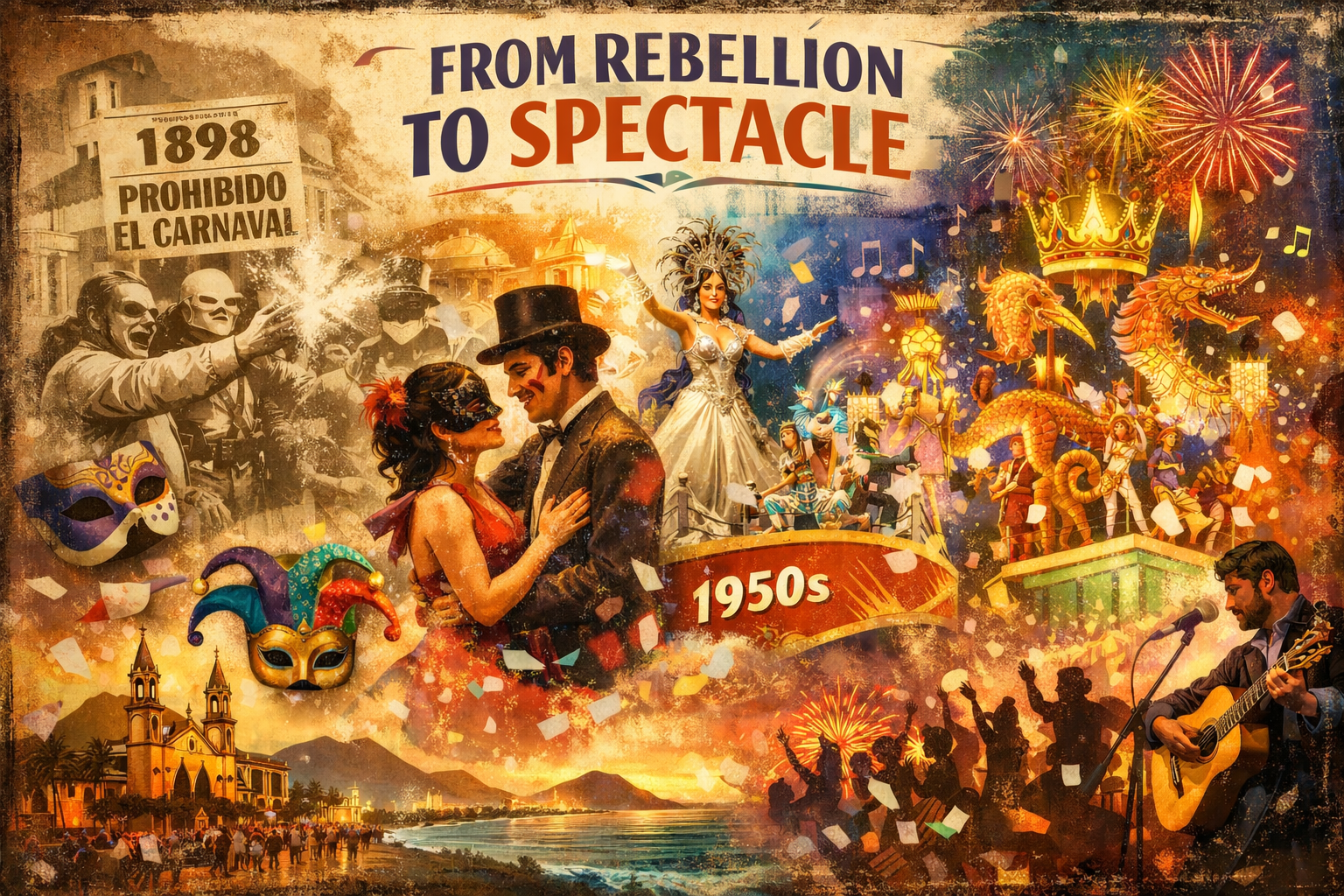
For more than 70 years, Carnaval unfolded as a spontaneous, unruly, and joyfully chaotic celebration, ruled by mascaritas, flour battles, and improvised comparsas. That began to change in 1898, when the city formalized its role by establishing committees, introducing decorated floats, encouraging intentional costuming, and shaping the street dances that would eventually evolve into the parades we recognize today.


Through the mid-20th century—especially in the 1950s—Carnaval continued to evolve. Cultural programming expanded to include concerts, performances, and fine arts. Design became more sophisticated, parades transformed into moving works of art, and the festival grew into a major attraction. It was during these decades that Carnaval took on the elaborate, organized, and highly anticipated form it has today.
Roots of Rebellion
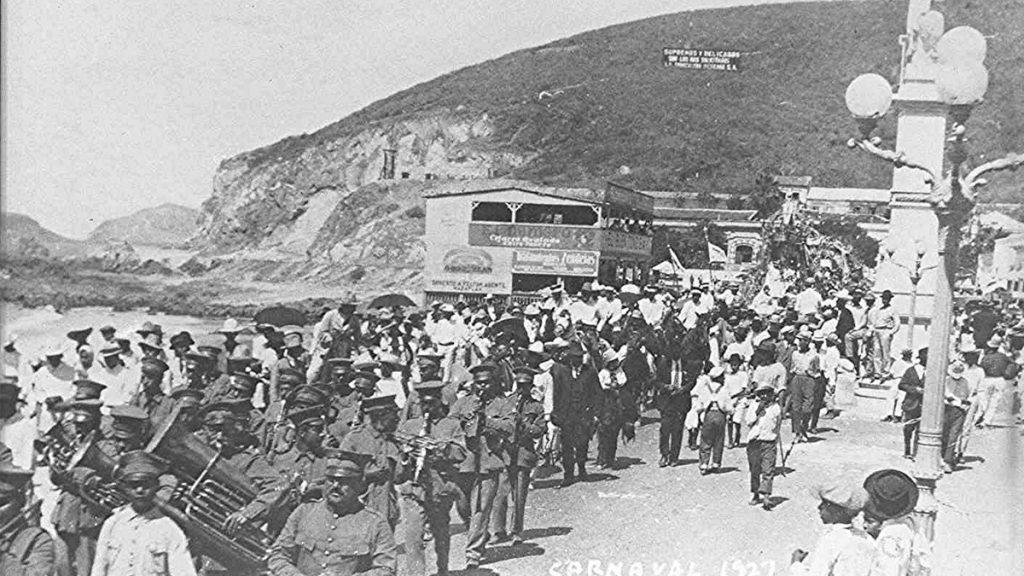
Although Mazatlán’s first documented Carnaval dates back to 1827, its spirit reaches far deeper. Its origins trace back to ancient pagan traditions reflected in the masked anonymity of Venice, the street revelry of New Orleans, and the explosive freedom of Rio de Janeiro. By the time these customs arrived in 19th-century Mexico, Catholicism had softened much of their wildness—yet Mazatlán preserved a distinctly rebellious edge.
Here, Carnaval began as a form of protest. Soldiers guarding the port, unpaid and living in harsh conditions, used masks and flour fights as a safe way to express frustration. That origin wove itself into the celebration’s identity: Carnaval as the people’s voice, a reflection of collective mood, joy, and political climate.
In fact, during the 1890s, a municipal decree attempted to outlaw the celebration entirely. The people resisted, and Carnaval endured.
A Cultural Mirror
Beyond the formal structures and dazzling displays, Carnaval acts as a cultural mirror for Mazatlán—a yearly reminder of the humor, resilience, and pride that define this community. And yes, it comes with traffic jams, construction zones, and a level of organized chaos that can make even the most patient residents consider leaving town for the week. It’s not uncommon for both seasonal and full-time residents to plan a strategic escape.
But beneath the messiness is a city reflecting its truest self.
There is something to be said for staying and allowing yourself to be swept up in the energy. Watch families line the sidewalks, waiting for the floats to tell their stories. Ask a longtime resident about their favorite Carnaval memory and notice how their face lights up. Nostalgia has that effect.
Wander through Plaza Machado before the festivities begin and observe the artistic interpretations of the previous year’s political, economic, and social shifts. There is so much to see—if you slow down enough to notice.

A Living Tradition
Carnaval in 2026 will not look exactly like the Carnavales of five, ten, or thirty years from now. Each generation remixes it—adding new elements, letting others fade, and reshaping the celebration to reflect its moment in time. That is the natural evolution of a living culture.
What remains constant is that Carnaval belongs to everyone. It is, at its core, a community celebration—shaped collectively and enjoyed collectively. And while the world around us can feel increasingly unstable, marked by social tension and concerns about safety, Carnaval has always had a unique ability to unify.

So as this year’s celebration approaches (February 12–17, 2026), perhaps the real question is this:
Where will you place yourself in this story?

Hopefully alongside your fellow Mazatlecos and neighbors—choosing connection over distance, and remembering what we share.