



The Beaver supermoon rises in Mazatlán at 5:24 p.m. on Tuesday, November 24, 2026, five minutes after sunset, in the east-northeast. That is the practical time to look up. The Moon turns exactly full at 7:53 a.m., but by then it has already set, at 6:30 a.m.
Moonrise, transit and moonset times below come from Timeanddate’s Mazatlán, Sinaloa tables, in local time. NASA lists this full Moon as a supermoon — the first of three in a row, in November, December and January.
What time can you see the supermoon in Mazatlán?
All times are local to Mazatlán (America/Mazatlan, UTC-7), from Timeanddate:
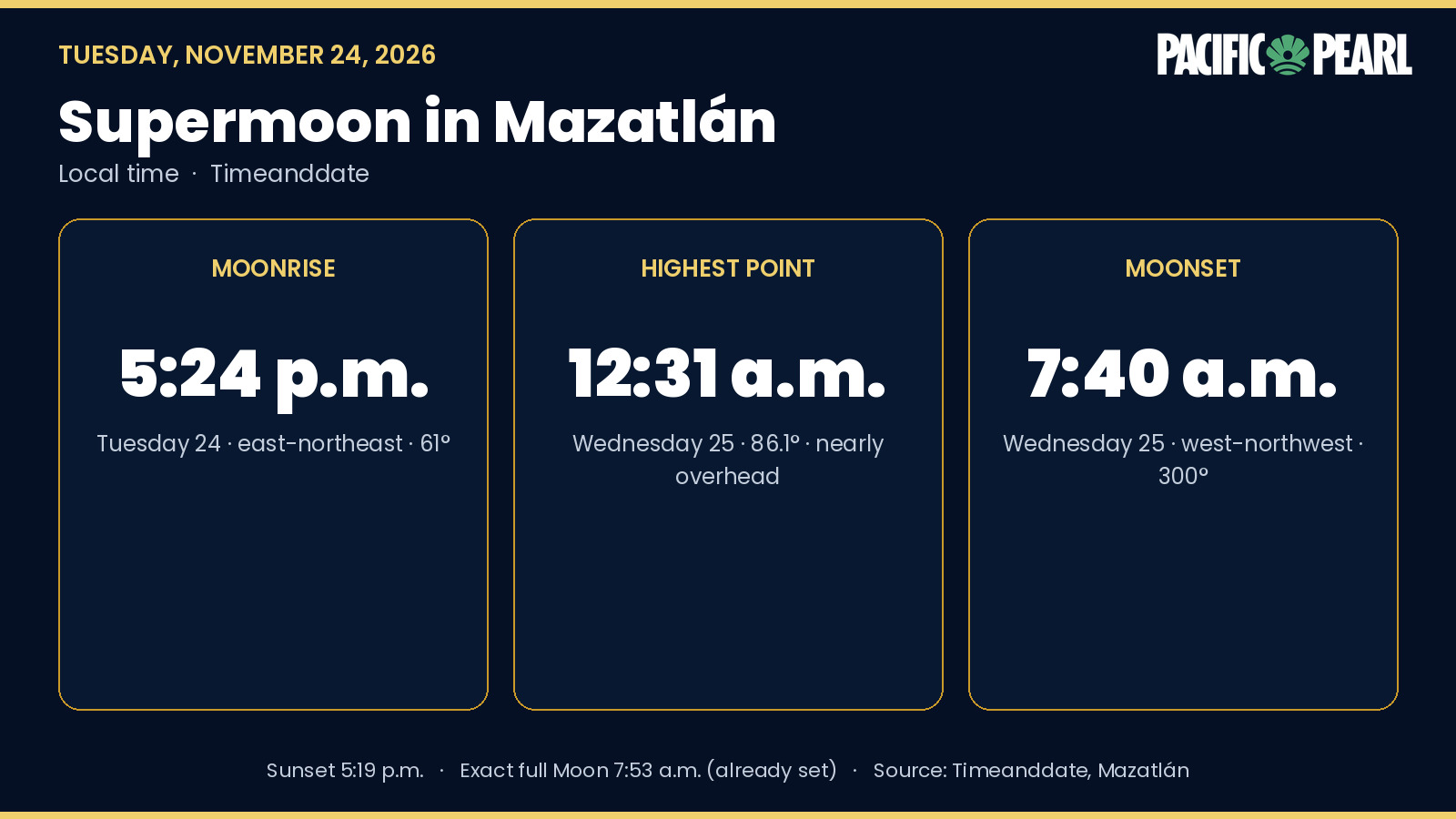
- Moonrise: 5:24 p.m. on Tuesday the 24th, at azimuth 61 degrees (east-northeast).
- Highest point: 12:31 a.m. on Wednesday the 25th, at an altitude of 86.1 degrees — nearly overhead. The Moon does not cross the meridian on the calendar day of November 24.
- Moonset: 7:40 a.m. on Wednesday the 25th, at azimuth 300 degrees (west-northwest).
The Sun sets at 5:19 p.m., and civil twilight ends at 5:43 p.m., also per Timeanddate. That puts moonrise in a darkening sky, with the disk still low on the horizon — when it often looks larger because of the Moon illusion. NASA notes that this effect happens with any full Moon near the horizon, not only a supermoon.
If you have a clear view to the east-northeast, that is where it will come up. Mazatlán’s malecón opens mainly toward the Pacific, to the west, so the disk may be easier to enjoy from there once it has climbed, or at dawn on Wednesday, when it sets in the west-northwest. No telescope is needed; a clear horizon is enough.
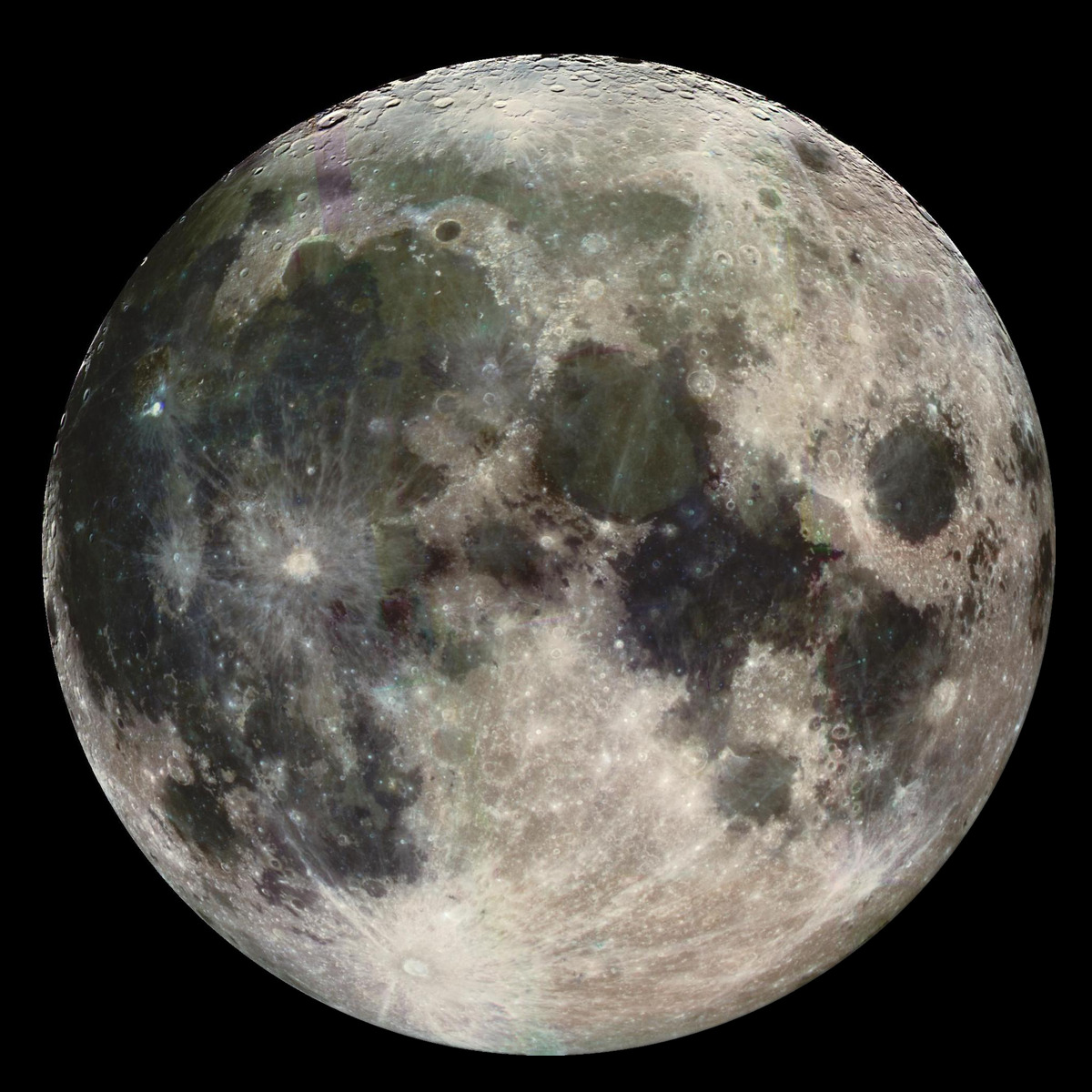
Photo: NASA/JPL (PIA00405, Galileo spacecraft). Public domain.
Monday night is already almost full
The exact full-Moon moment is an instant, but the disk looks full to the eye the night before and the night after. On Monday, November 23, Timeanddate has moonrise at 4:27 p.m. in the east-northeast (65 degrees) and a culmination at 11:26 p.m., 88.8 degrees high, at 99.6 percent illumination. That night’s moonset is the 6:30 a.m. setting on Tuesday.
Is it a supermoon? The Beaver Moon
Yes. Timeanddate classifies it as a Super Full Moon and labels it the Beaver Moon, the traditional English name for November’s full Moon. It is not an official International Astronomical Union term; it is the popular name used by almanacs and sky guides.
NASA, in its November skywatching guide and its supermoon explainer, lists November 24 as a “Full supermoon” and notes that “supermoon” is not an official astronomical term either. The definition NASA says is typically used is a full Moon near perigee — the closest point in the Moon’s orbit — usually when it comes within at least 90 percent of that closest approach.
Timeanddate puts the Earth-Moon distance at 360,766 kilometers at the full-Moon moment. This month’s perigee falls on November 25, at 359,347 kilometers. On Timeanddate’s Mazatlán phases page, the full Moon is at 7:53 a.m. on Tuesday the 24th, or 14:53 UTC. NASA publishes the same event at 14:54 UTC, one minute later, a common difference between almanacs.
Will it look much bigger? It depends on the comparison. Timeanddate estimates a full supermoon is about 6 percent larger and 16 percent brighter than an average full Moon, a change that is hard to see with the naked eye. NASA uses a different yardstick: compared with the farthest, faintest full Moon of the year, the disk can appear up to 14 percent bigger and 30 percent brighter. In both cases the difference is subtle. What often looks dramatic is the Moon sitting low next to buildings or trees, thanks to the Moon illusion.
The next supermoon, according to NASA and Timeanddate, is December 23, 2026: in Mazatlán the full Moon falls at 6:28 p.m.
What the sky forecast says
The Open-Meteo model, checked on Monday, November 23, at about 8:25 a.m. Mazatlán time, shows no rain on Tuesday. It does point to a cloudy moonrise: 100 percent cloud cover at 5:00 p.m. and 99 percent at 6:00 p.m., still overcast at 7:00 p.m. At 8:00 p.m. the same model eases to 75 percent (partly cloudy). After midnight it improves: 35 percent at 1:00 a.m. and 10 percent at 2:00 a.m. Wednesday.
That is a forecast, not a guarantee. Cloud cover can change in a few hours. If the disk is hidden at 5:24 p.m., the night is not over: at 12:31 a.m. Wednesday the supermoon in Mazatlán passes nearly overhead, and it does not set until 7:40 a.m.