



Joel Isaías Barraza
Odiseo Luna handled the nylon fishing line as though trying not to disturb the surface of the sea with sudden, unexpected movements. A streak of white foam marked the spot where the line cut through the waters left behind by the shrimp trawler.
A sudden tug pulled out more than six meters of line, prompting Odiseo to steady the rod and carefully reel it back in. At last, a zigzagging silver flash began approaching the small vessel until, with one careful pull, it was lifted aboard and landed trembling on the wooden deck, revealing itself to be a magnificent fish weighing more than seven kilos.
“It’s a mahi-mahi,” said Jasón, Odiseo Luna’s eldest son, grabbing a baseball bat from beside the boat hook and delivering a decisive blow to the captured fish’s head. As if by magic, the creature stopped thrashing, while the colors and markings of its beautiful, streamlined body slowly faded.
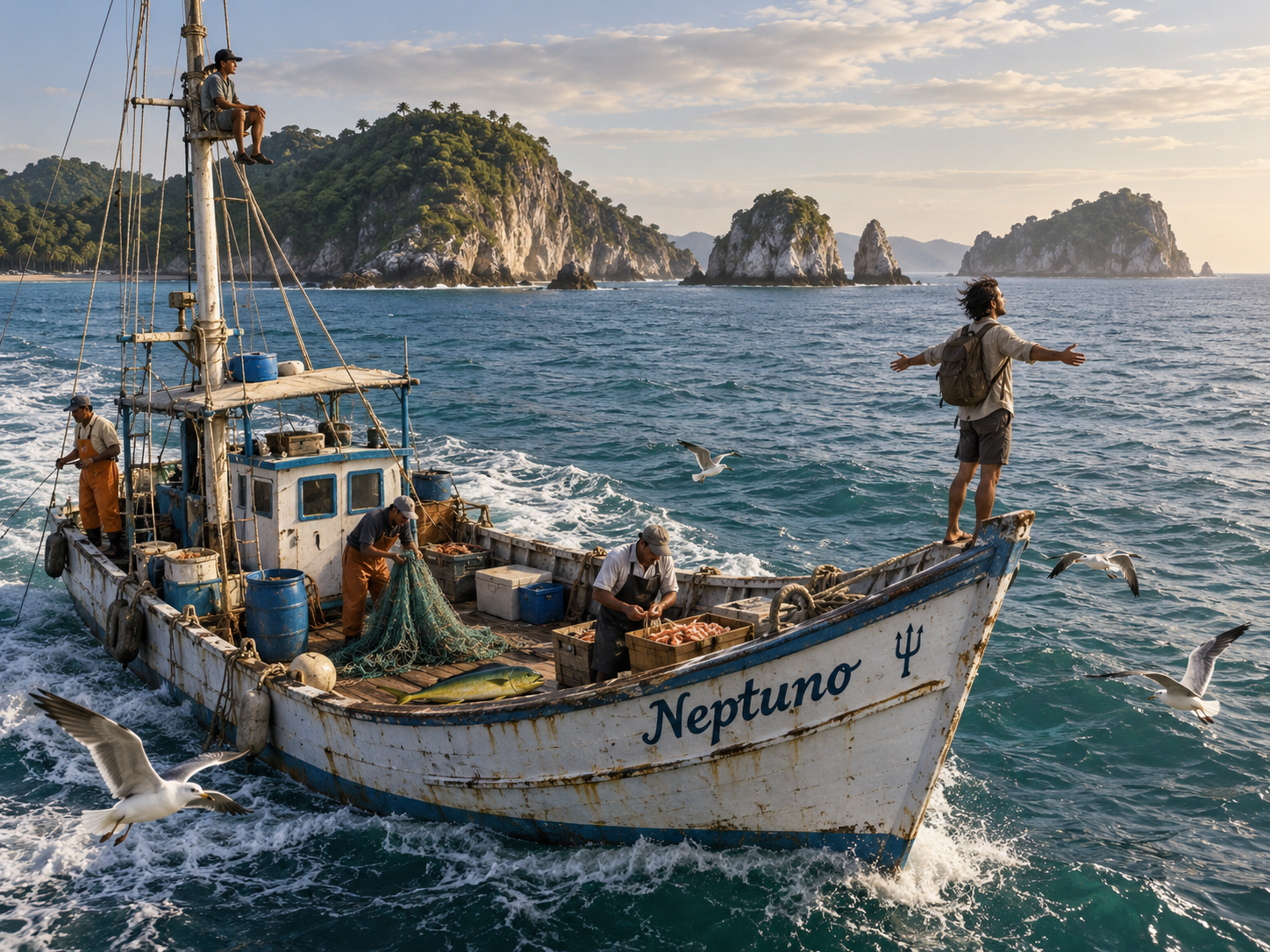
The Neptuno sailed swiftly. In less than an hour, it passed between Venados and Pájaros Islands, two rocky mountains covered in the dense greenery of the tropics, ancient natural barriers against the cyclones that threaten the port’s bays. I stood at the very tip of the bow, facing the open ocean, as though flying above the green and blue ripples of that mineral elixir that never ceases to move.
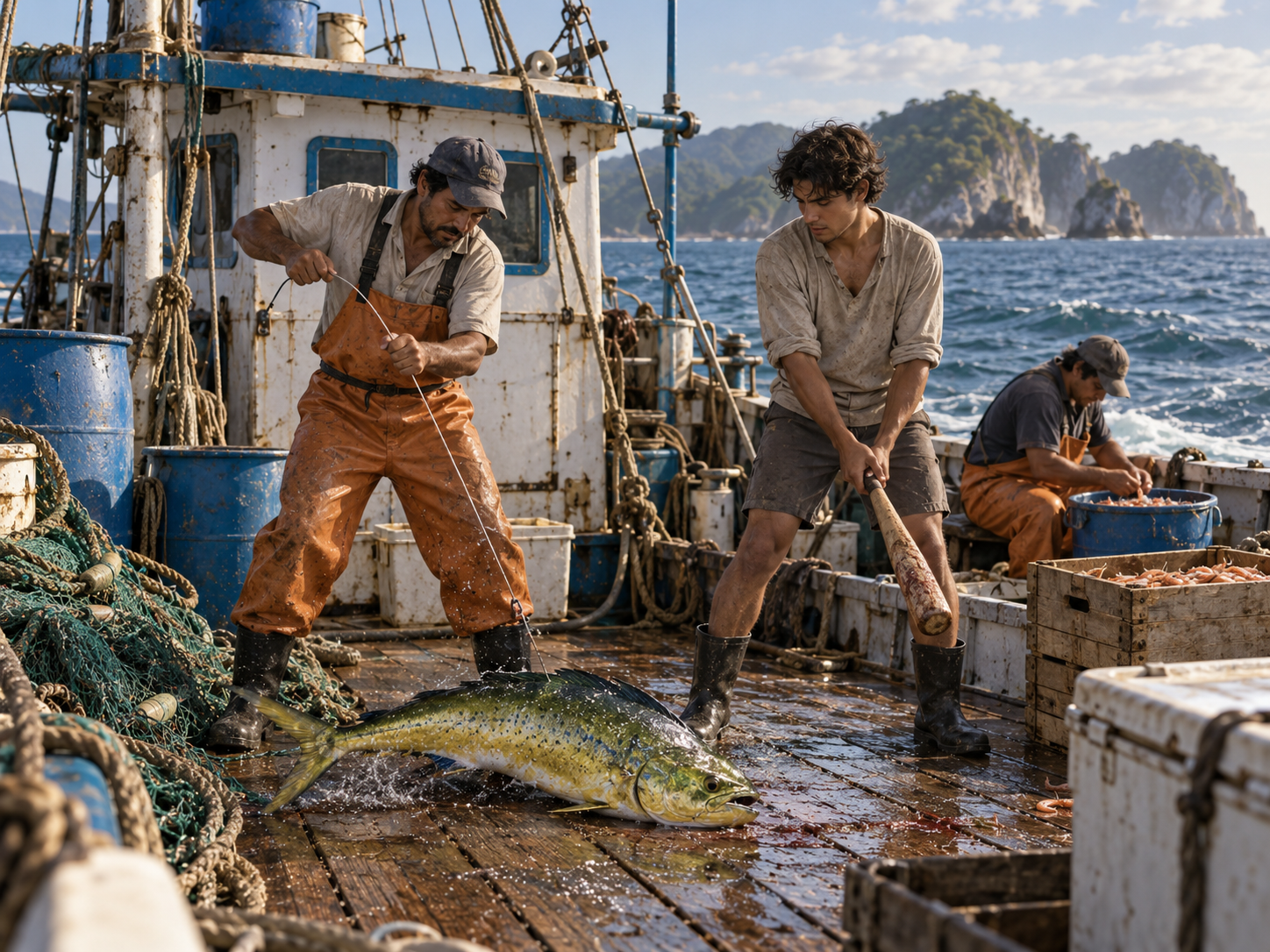
“The way you’re standing there, even the boat disappears,” said Matías, seated on the port side while cleaning a bucket of shrimp. His duties as cook allowed him little time to rest. In addition to preparing the crew’s three daily meals, he helped haul in the nets, cleaned the deck with the assistance of the pavo (the young deckhand), washed the dirty dishes, and lent a hand whenever the unexpected arose. At that moment, he was removing shrimp heads.
From the wheelhouse, Odiseo watched the silhouette of the tiburón—the nineteen-year-old winch operator—while, off to the right, several dozen argentatus gulls flew low over the water.
At the very top of the mast, wearing shorts, a T-shirt, and white sneakers, the pavo enjoyed the seascape while reciting verses he claimed had been written by his great-grandfather, a certain Genaro Estrada:
To the green waters I shall return one day, Anointed in the ritual of cyclones, Waving the palms of the coast in my right hand And singing the sailor’s clear song. To the green waters, with bare feet And a chest made hoarse from shouting at storms.
“But you’re not even from Agua Verde!” shouted the tiburón. “You’re from Colonia Juárez, number 25, Privada de la Puntilla!”
As though listening only to the wind, the pavo continued:
I shall arrive upon the shore of farewells, With winds adorned by waving hands And the bitterness of seas and tears, To enter the water with my arms Raised toward the heavens, and within the waves Submerge the reverence of my body.
Applause erupted across the deck as the crew cheered, while the tiburón whistled mockingly and hurled squeezed orange peels at the pavo. From the highest point of the little shrimp trawler, the young deckhand greeted his friendly audience, the immense and restless sea, the coastline still visible in the distance, and the gulls that accompanied him, gliding above his head and within his gaze.
“Lower the outriggers! Get the nets ready!” Odiseo Luna’s voice thundered through the wheelhouse windows.
The crew of the Neptuno heard the command and hurried to their stations. The very moment the nets touched the water, the winches positioned on either side began to squeal at the ends of the outriggers. The steel cable slowly unwound from its drum until, just minutes after the maneuver had begun, the tiburón shouted:
“That’s it over here! We’ve reached the bottom on the port side!”
Before he could finish reporting, the sound of the starboard outrigger striking its position was heard.
“Let out another forty meters!” Odiseo ordered from the wheelhouse.
All around the vessel—or rather, in every direction—the sea went about its silent work. It rinsed the timbers, corroded the metals, crumbled rocks that would one day become sand, dissolved illusions, and drove crustaceans into the tightly woven nets of the floating homes. It blew cool breezes across the warm bodies inhabiting the coastlines.
The monotonous turning of the pulleys came to a halt under the strength of the tiburón, who worked the winch lever. He remained motionless beside the boat’s boom, keeping watch over the steady, even drag of the pair of trawl nets.
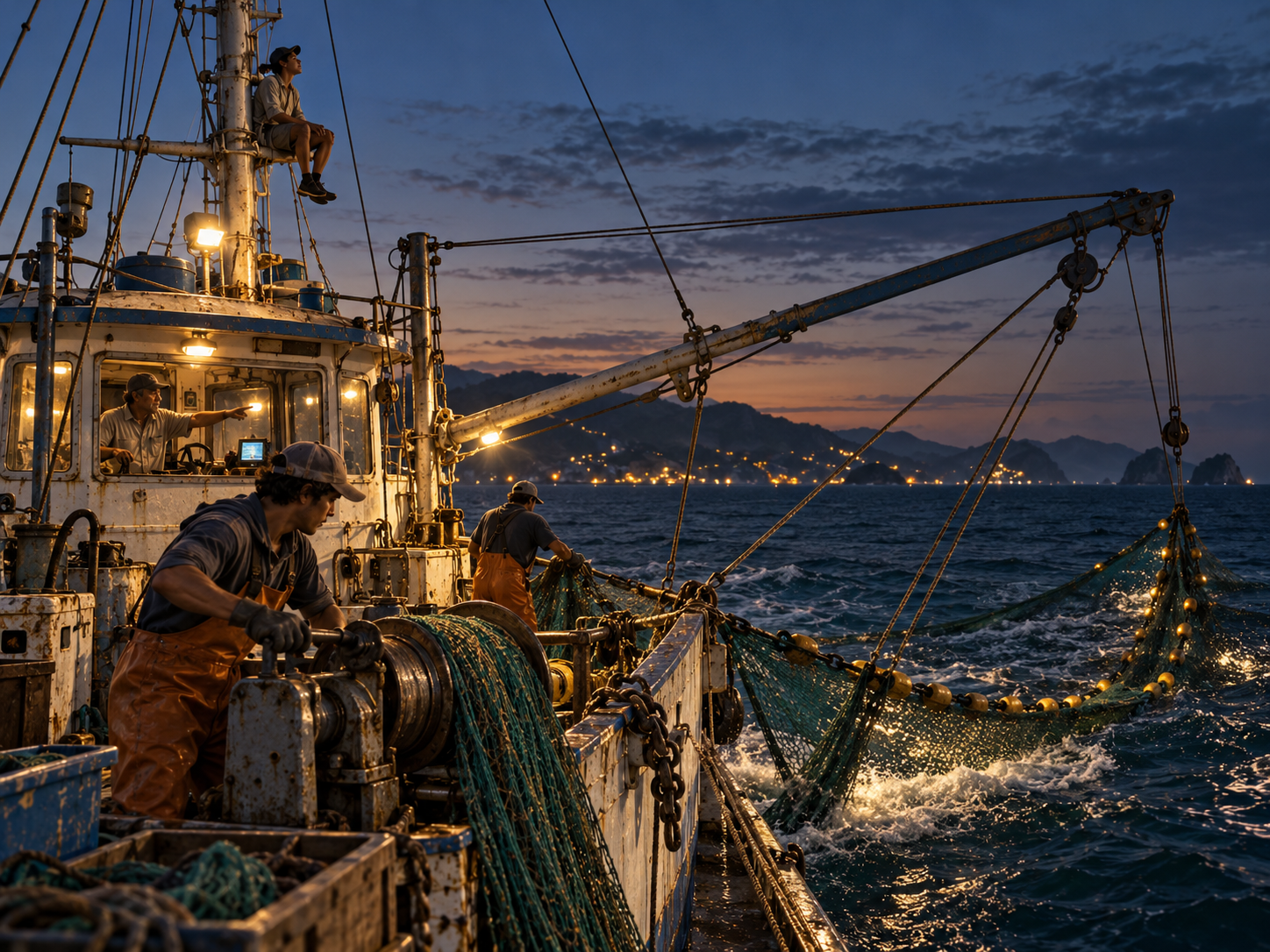
In the distance, the lights along the coast began to glow, trembling fireflies of different sizes. They seemed to greet the Neptuno as it ventured into the ocean night with its arms outstretched and its nets pulled taut, carrying the humble intuition that the shrimping season now beginning would be a good one.
After the maneuver, Matías, the cook, washed his hands and headed toward the small storage room, announcing:
“I’m going to make coffee for everyone, and I’ll make it nice and strong, because it looks like this first night is going to have us working mighty hard!”
“Hey, deckhand!” he shouted. “See if you can remember a poem about the sea at night.”
Sitting beside me, Estrada had just taken out his cigarettes and offered me one. I took a cigarette from the pack and handed it back. As I lit mine from his, I heard him recite, in a strong and cheerful voice, something not very widely known:
Beneath the night, from aboard the ship, The same questions have arisen: —Do we truly know where we are going? —Could we have taken the wrong course? Long ago we left the land behind, And across the sea of adventure We shall arrive tonight At the capital of the Moon…
Enrique González Rojo (Sea Beneath the Moon).